

What Percentage Of Women In Ukraine Wear Makeup
Major Ethnic Groups Of Ukraine
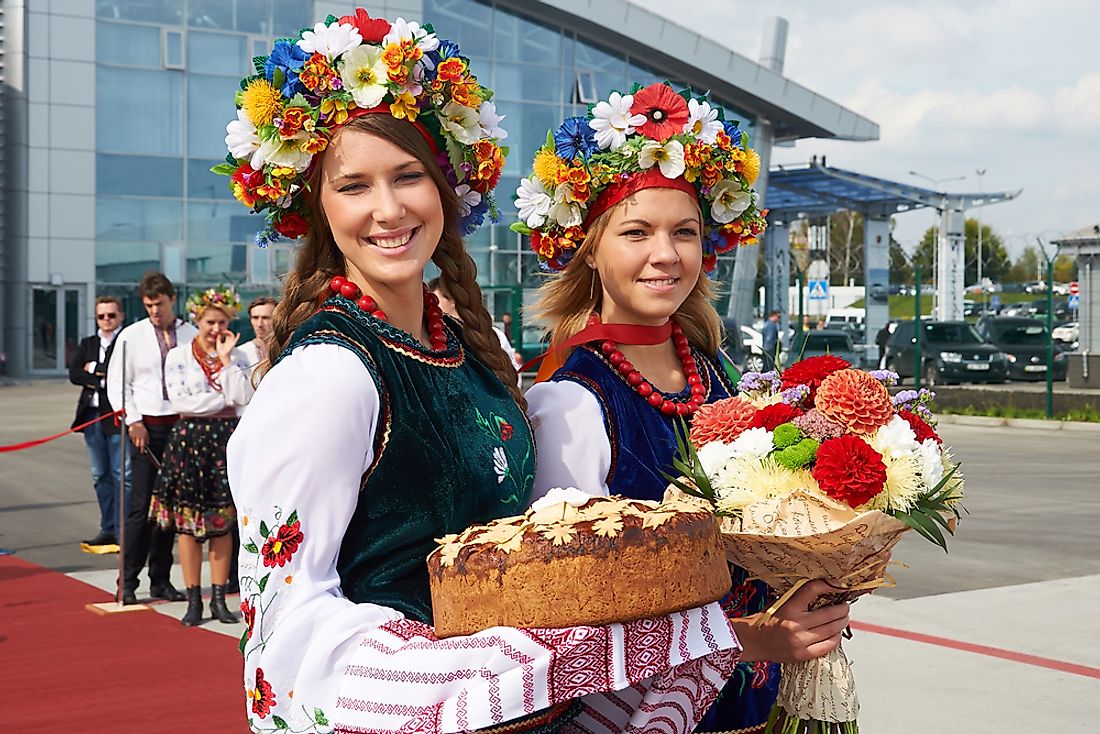
Subsequently achieving its independence in 1991, Ukraine has been tasked with uniting its various regions and creating a distinct national identity. Equally the country is home to more than a hundred different nationalities, this presents some circuitous and pregnant challenges.
Indigenous divisions in Ukraine go back to the imperial period when regional borders were heavily disputed by Russian federation, Austro-Hungary, and the Polish-Lithuanian Commonwealth. Southeast Ukraine has historically been populated by ethnic Russians and Russian-speaking Ukrainians, with shut cultural and economic ties to Russia. Much of western Ukraine was part of Habsburg Austria until 1918; while other regions were brought into Ukraine after Globe War Ii, and the area maintains stiff ties with Europe.
Roughly 77.five% of Ukraine's population identify as ethnic Ukrainians. The second largest nationality group are Russians, bookkeeping for 17.ii% of the population. Other significantly represented nationalities include Romanians, Belorussians, Crimean Tatars, Bulgarians, Hungarians, Poles, Jews, and Armenians.
Russian
The Russian community in Ukraine is primarily located in Crimea. The Russian Empire captured and began to colonize the largely uninhabited steppe territories in the former Crimean Khanate in the tardily 18th century. The discovery of coal in the Donets Basin sparked big-scale industrialization and an influx of laborers from other parts of the Russian Empire. During the Russian Civil War, Ukraine became a battleground between the Communist Cherry Army and the Monarchist Volunteers. Ukraine became the Soviet Socialist Democracy in 1992, and in a 1997 treaty between the two countries, Russian federation agreed to recognize Ukraine's current borders.
Romanian
In 1918, Bukovina and Bessarabia were united with the Kingdom of Romania. Ukrainian population in the region were forced to change their names, their languages, and Ukrainian schools and cultural institutions were closed. After the Russian Civil War, the area was annexed by the Ukranian SSR. A 1997 treaty guaranteed the rights of Romanians in Ukraine.
Belorussian
About Belorussians emigrated to the Ukrainian SSR during the Soviet Union. Different nigh other indigenous groups, they are spread fairly evenly throughout the land. Belorussian nationals have reportedly been divided betwixt both sides during the recent disharmonize in Ukraine.
Crimean Tatar
Crimean Tatars are descended primarily from Turkic tribes who emigrated to Eastern Europe from the Asian steppes from the 10th century onward. The unabridged population was deported to Uzbekistan in 1944. Today, more than 250,000 Crimean Tatars have returned to their homeland, now part of Ukraine, and struggle to reclaim their heritage, as well equally national and cultural rights.
Bulgarian
Many Bulgarians settled in what is now the Odessa Oblast during the Ottoman Empire and afterward the Russo-Turkish Wars in the 18th and 19th centuries. The area inverse easily several times: divided between Russia and Romania, ceded to Russia in 1878, recaptured by Romania in 1918, so it became part of the Soviet Spousal relationship.
Hungarian
Ukraine'due south territory of Zakarpattia was originally part of the Kingdom of Republic of hungary. Disputed over past Romania, Ukraine, and Hungary, information technology was awarded to the newly formed Czechoslovakia earlier being incorporated into the Ukrainian SSR. A 1991 treaty guaranteed the rights of Hungarians in Ukraine, although dual citizenship is not officially recognized.
Smooth
In the 16th and 17th centuries, Poland sponsored large-calibration Polish colonization of central and eastern Ukraine. After the autumn of Austro-Hungary, the Smooth population successfully rebelled against the newly-formed West Ukrainian regime. During the Soviet era, Poles were deported to Siberia, and a campaign of indigenous cleansing was carried out past Ukrainian nationalists.
Jewish
Jewish communities have existed in Ukraine for more than than a thousand years. According to the World Jewish Congress, the Jewish community in Ukraine constitutes the tertiary biggest Jewish community in Europe and the fifth biggest in the world. Massacres and pogroms frequently took place in the 19th and 20th centuries. The bulk left Ukraine subsequently the fall of Communism, merely antisemitism continues to exist problematic for the remaining population.
Armenian
The Armenian population in Ukraine has nearly doubled since the terminate of the Soviet Union. They nevertheless maintain shut ties with Russia: 50% are native Armenian speakers, but over 43% speak Russian, and merely 6% speak Ukrainian as their get-go language.
Ethnic minorities bring to Ukraine a rich and diverse cultural heritage. However, integrating them into a united Ukraine volition require conscientious planning and implementation of government policies.
Major Ethnic Groups Of The Ukraine
| Rank | Ethnic Group | Share of National Population of Ukraine |
|---|---|---|
| one | Ukrainian | 77.5% |
| ii | Russian | 17.2% |
| 3 | Romanian | 0.8% |
| 4 | Byelorussian | 0.6% |
| 5 | Crimean Tatar | 0.5% |
| vi | Bulgarian | 0.4% |
| 7 | Hungarian | 0.3% |
| 8 | Smoothen | 0.iii% |
| 9 | Jewish | 0.2% |
| x | Armenian | 0.2% |
Source: https://www.worldatlas.com/articles/major-ethnic-groups-of-the-ukraine.html
Posted by: petersoncousise.blogspot.com
0 Response to "What Percentage Of Women In Ukraine Wear Makeup"
Post a Comment